"A House for 15 Cats and 5 Dogs" [Keiji Hirose] 1/2
The Cats' House is a residential work that holds a special place in my heart. Packed to the very limit with a density of ideas unmatched anywhere in the world, this house — overflowing with love for cats — was made possible not so much by my own abilities, but by the wholehearted love the H family has for their cats, and their complete trust in my design. Whether I lived up to that trust and expectation one hundred percent — the house was only completed two months ago, so I can't yet say for certain. But looking at the images of the cats introduced on this site, I believe it was, more or less, a success. Good work was done.
The H family consists of a couple and their daughter — three people in all. At the time of the initial design, there were 15 cats and 5 dogs in the household. In November 2008, during the design process, a cat named Ron passed away from illness, and the family's grief was immense. Yet the wife bravely continued to participate in the design meetings for the new home. The design reached its initial completion in January 2009, and the final refinements were finished in April 2009.
After that came the demolition work and the temporary relocation. During that time, two new members — Kai and Maru — joined the family, bringing the total to 16 cats and 5 dogs. The Cats' House was finally completed in August 2009. The title "A House for 15 Cats and 5 Dogs" comes from those circumstances. Since the original commission was received in February 2008, it was quite a major project — a considerable amount of time for a simple two-story wooden house.
Because so much of the "cats-only" design was so far removed from common sense, over 30 perspective drawings were created for communication purposes, and the construction drawings — excluding shop drawings — totaled 90 sheets. For a simple, conventionally framed wooden house of around 40 tsubo, this is an extraordinary number.
Thanks to all that effort, the site foreman and carpenters perfectly understood the "for the cats" concept, and what stays with me most from this project is the sight of the carpenters who came to see the house after the move-in, watching the cats move happily through the spaces they had built — eyes soft with quiet satisfaction.
"A House for 15 Cats and 5 Dogs" [Keiji Hirose] 2/2
The design request for this "large family" of 24 individual animals was not "a house for three adults living with pets," but rather "please create a house for the cats." (Of course there were requests regarding the dogs as well, but for the nature of this site, I will omit them here.)
"Ordinary house" concerns can be secondary. And when I was seriously asked, "What exactly is an ordinary house?" — I felt a sense of surprise, and something within me seemed to come loose. If it wasn't just my imagination.
Now — having learned a great deal from the H family (and especially the wife), who had properly raised over 10 cats as fully indoor pets for many years, linking the "ethology of cats in confined spaces" to "architecture" and devising designs and devices for cats during the design process was a blissful time that was the pinnacle of a designer's work. And yet, inserting "a human dwelling" inside "a cat's house" required considerable effort.
To begin with, the very fact of struggling over where humans should live while designing a house seems rather "not normal" in itself — yet in a way that rationally explains the answer to "what is an ordinary house?", the living room and dining room quite easily lost their reason for existence.
During the design period, the act of "creating something that doesn't yet exist" brought various clashes of opinion. But those, too, are good memories. Looking back, I sometimes feel a touch of sentimentality, thinking that I will probably never again be involved with a family like the H family.
Through all of this, I feel I've come to understand, at least a little, the state of mind of Margarethe — the wife of Konrad Lorenz, founder of modern ethology, who was so thoroughly swept up in his work. Finally, I would like to express my deep gratitude to the H family for their cooperation in the long photo shoot for this site, and close my words here. [Keiji Hirose / Fauna+DeSIGN]
"The Cats' House" [Dominic Young] 1/2
Although there are countless people who love animals in the world, residential spaces specifically designed for the comfort and well-being of pets are relatively rare — which is peculiar. The Cats\' House, designed by Keiji Hirose of Fauna+DeSIGN, a design office based in Japan, is precisely such a dwelling. Hirose has brilliantly wielded his dual expertise as both an architect and licensed animal behaviorist, creating a dream home for humans and their "other halves" — the animals.
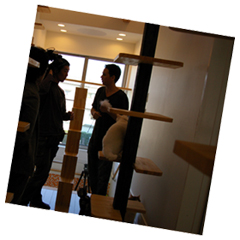
I was privileged to visit the Cats\' House in autumn 2009. The aspect that left the deepest impression was the countless aerial pathways, walkways, and tunnels that crisscross the entire two-story structure at varying heights. This network of cat pathways represents the pinnacle of good design — merging functionality, aesthetics, and a wealth of delight. The most striking feature is a sinuous "cat walkway" that passes overhead at ceiling height through the central stairwell — a brilliant display of the house\'s feline residents, their coats in various colors, lounging languorously from above. Hirose explained that these pathways provide cats with "vertical" movement space from an animal behavioral perspective, as well as room to roam. The latter is especially important given the concentration of so many animals in one space. After all, cats have their own hierarchies, and ample dispersed space allows the weaker members to evade the stronger ones — even to hide and not be found. In theory, this reduces conflict — and conversations with the owner confirmed this, resulting in significantly reduced stress for all residents.
"The Cats' House" [Dominic Young] 2/2
Other design elements throughout the house similarly balance aesthetics with function: a water bowl positioned at floor level with continuously refreshed drinking water; and acrylic tube partitions — simultaneously isolating cats from certain zones while maintaining visual continuity. Overall, the house is comfortable and stylish, and judging from how well the 16 cats have adapted, it has clearly been embraced by its "residents." It is foreseeable that demand for such concept homes will continue to increase in the future. Perhaps one day, a typical human-centered house will seem unsuitable to any serious cat lover. [Dominic Young]
"The Baroque Quality That Animals Bring to Modern Architecture" [Hiroyuki Higuchi] 1/3
The work of architect Keiji Hirose (born 1969) presents an exterior that looks like the very model of a modern Japanese house. But the moment you step inside, that impression is completely transformed.
Where sliding doors should ordinarily be used, cage-like lattice doors have been fitted; rough rope is wrapped around the columns. And at roughly eye height, slender boards are laid across like aerial corridors. These long, narrow pathways run through the entire house; where they meet a wall, a tunnel opens and connects to the next room.
In places, these pathways connect to strange columns that resemble simplified spiral staircases. What's more, these spiral staircases penetrate the ceiling and reach the second floor, where they reconnect to the aerial corridors. Along the walls and ceilings facing these pathways, small windows have been pierced here and there — as if to say, "I was making my way along the corridor and felt a sudden curiosity about what was outside, so I opened a window here."
In essence, his architecture features doors that should obstruct the view replaced by cage-like lattice; and ceilings and walls that should likewise obstruct the view given a porous structure riddled with openings and windows — through which aerial corridors and spiral staircases run in every direction. It has the appearance of a labyrinth or an amusement park. Moving through this strangely transparent, porous space, one becomes caught up in a kind of "play of gazes."
Yet at the same time, Hirose's architecture is composed almost entirely of straight lines: a simple design. There is nothing that could be called decoration. The architecture of his hand is structurally peculiar, but its surfaces are ascetically plain.
Now, what should we call this characteristic of his architecture's interior — ascetic in decoration, yet extraordinarily playful in structure? I would call it Baroque.
"The Baroque Quality That Animals Bring to Modern Architecture" [Hiroyuki Higuchi] 2/3
In general, modern architecture is characterized by functionality and mass-producibility, and — with exceptional works like the Chapel of Ronchamp aside — it dislikes curves and curved surfaces. Still less is modernism compatible with porous, playful structures or spiral staircases. It is Baroque architecture, generally speaking, that favors such porosity, playfulness, and helical forms. In other words, Hirose's architecture, despite its modern, plain exterior, contains an interior structure that is extremely Baroque.
So why did Hirose introduce Baroque playfulness into modernist architecture? The answer lies in animals.
In fact, Hirose is an architect deeply versed in animal behavior — particularly the ecology of pets — and the architecture he designs incorporates structures designed to prevent problem behaviors in pets. The rough rope wrapped around the columns is for cats to sharpen their claws; the aerial corridors and spiral staircases are highways for the cats to travel.
The use of lattice doors instead of sliding panels, and the irregular openings in walls and ceilings, also reflect consideration for the psychology of pets. When confined in an interior space, they suffer from claustrophobic stress and often exhibit problem behaviors. The windows pierced everywhere are also designed to prevent this kind of stress.
The Baroque playfulness of Hirose's architecture is a necessary product of incorporating the playfulness that is essential to animals as living beings. He names this kind of design — based on ethology — Fauna+DeSIGN: architecture designed not only by human logic, but by bringing in the animal's perspective as well, and finding a synthesis of the two.
Animals simply do not live within the bounds of the rational behavior that humans prescribe. The Baroque quality that is necessarily introduced in order to coexist with them — that is the law that defines Hirose's architecture. While observing the modernist axiom of "the machine for living," his architecture, rich in playfulness, is an unwitting work of postmodern architecture.
"The Baroque Quality That Animals Bring to Modern Architecture" [Hiroyuki Higuchi] 3/3
Now then — what would happen if a client with no habit of living with pets commissioned a house from him?
In fact, Hirose's architecture often features spaces where only children can sit. Beneath the railings of staircases and mezzanines, he deliberately leaves gaps without knee walls, so children can perch there. Hirose also intentionally places windows low when designing homes for families with children. Children grow up sitting in places that are mere stairways for adults, and gazing out of windows positioned where adults cannot peer in. These are "seeds of play" embedded in the architecture for children.
Hirose's architecture is also designed on the premise that it will be seen from a variety of angles — the gaze of children, the gaze of animals, and many other perspectives. His architecture has visual devices that change their expression depending on the height of the viewer. He considers the eye level of animals, the eye level of children, and the eye level of adults, and completes his designs by examining them from all these angles.
Animals play through these devices, relieving stress and regaining calm. And children, in the course of growing up, discover the "seeds of play" embedded in the interior, play with them, and as they grow, encounter different views. Even if the client is an adult household with no children and no pets, this playfulness remains unchanged. Hirose's architecture, which shows an entirely different expression when standing versus sitting, is filled with a rich visual playfulness. This multi-layered playfulness is the central theme that forms the foundation of his architecture.
The architecture of Keiji Hirose is fundamentally conceived within the framework of modernism, and even structures that appear strange at first glance are rationally derived from the goal of preventing problem behaviors in animals. Yet at the same time, his architecture always contains "play" somewhere. For animals, for children, and for adults with a sense of play — his architecture is designed for them.
Alongside the drive towards rationality, the desire for irrational play always exists somewhere — that is human life. A modern yet Baroque architectural form that responds simultaneously to both rationality and the desire for play. That is the architecture of Keiji Hirose. [Hiroyuki Higuchi]